Choosing the right spray gun for upholstery adhesive determines whether your fabric bonds cleanly or turns into an expensive, stringy mess. Conventional siphon-feed guns with 1.8mm–2.5mm nozzles dominate commercial upholstery work. Pressure pot systems win for high-volume production. HVLP works, but struggles with thick contact adhesives. This guide breaks down exactly what to buy and why.
I’ve seen perfectly good contact adhesive get ruined by the wrong applicator. The fabric wrinkles. The foam melts. The bond fails three weeks later when someone sits down. Not ideal.
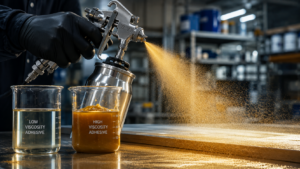
Because adhesives are more viscous and shear differently than most other liquids commonly sprayed, you need to spray them with a conventional spray gun or a gun specifically designed for adhesives and glues.
That rules out a lot of off-the-shelf paint guns that look deceptively capable on the shelf.
The commercial upholstery and textile laminating space has distinct requirements. You’re dealing with contact adhesives, high-tack formulas, and substrates ranging from delicate woven fabrics to dense polyurethane foam. Getting the equipment right isn’t optional. It’s the job.
This is the workhorse of the upholstery world. Reliable, affordable, and brutally effective for contact adhesives.
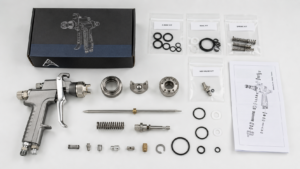
Almost always, upholstery professionals use old-school siphon-feed spray guns with fairly large tips 1.8mm is pretty common.
These guns operate at higher air pressures, typically 60–90 PSI, which is exactly what thick contact adhesives need to atomize properly.
Conventional spray guns utilize air at a higher pressure than HVLP spray guns. The benefit is that regardless of how thick the coating is, it can be atomized by increasing the pressure.
For heavy-bodied contact adhesives the kind used to bond vinyl to foam or fabric to furniture frames that atomization capability is non-negotiable.
The tradeoff?
Transfer efficiency is significantly reduced to around 35 percent, which results in extra coating waste and increased coating costs.
If you’re doing high-volume production, that waste adds up. But for most commercial upholstery shops, the simplicity and raw power of a conventional gun justifies it entirely.
If you have heavy-bodied coatings like glues, epoxies, and zincs, conventional air caps often make the most sense. They’re also the perfect option for a tight budget as they’re cheaper than HVLP and LVMP guns.
Think of a pressure pot as the grown-up version of a siphon-feed gun. Same gun, bigger reservoir, no gravity dependency. It’s the go-to setup for commercial operations bonding large surface areas boat interiors, automotive headliners, furniture production lines.
Upgrading to a 2-quart pressure pot works much better for high-volume use, and trying to spray upside down is a real pain with a siphon gun.
Anyone who’s tried to bond a headliner from underneath will tell you the same thing.
A Binks 2001 gun with a 2.8mm tip paired with a Devilbiss pressure pot is a known commercial-grade setup
used by professionals spraying contact adhesive daily. It’s not cheap. But it’s also not something that clogs mid-job.
Pressure pot systems maintain consistent feed pressure independent of adhesive volume. That means uniform spray patterns from the first pull of the trigger to the last drop in the pot which is exactly what a textile laminating spray system on a production floor demands.
HVLP spray guns offer a soft spray that reduces overspray and coating waste. The drawback is that thick coatings are often not able to be atomized well.
So where does HVLP fit in the upholstery adhesive applicator conversation? Lighter water-based adhesives. Fabric stabilizers. Pressure-sensitive spray adhesives with lower viscosity.
3M spray adhesives applied through appropriate equipment apply easily and evenly, sticking quickly yet with sufficient open time for repositioning, and are adaptable for automated systems.
But if you’re reaching for a solvent-based contact adhesive or a high-tack formula for automotive or marine upholstery? HVLP is not your tool.
For contact adhesive, use a cheap gun conventional, not HVLP. You’re looking for a percentage of coverage, not a fine finish.
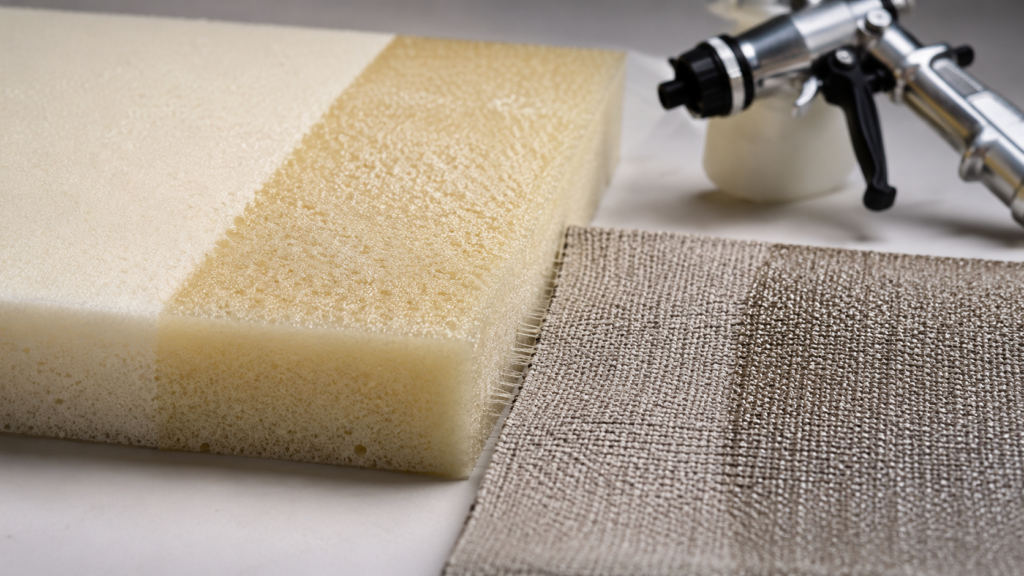
Nozzle selection is where I see commercial buyers make the most mistakes. They default to whatever came in the box.
Nozzle sizes typically range from 1.0mm to 2.5mm. Smaller sizes like 1.4mm are good for thin materials, while 2.0mm+ suits thicker coatings.
Contact adhesives are thick coatings. Full stop.
A purpose-built adhesive spray gun can spray most types of liquids thick or thin such as adhesives, paints, ceramic glazes, and oils. You can adjust the tip and air pressure for different liquids and spray patterns.
That adjustability is critical when you’re switching between a lightweight fabric adhesive and a heavy-duty contact cement in the same session.
For most commercial upholstery bonding, I’d recommend starting at 1.8mm and working up from there. Running at 70–90 PSI gives you consistent atomization without the stringy webbing that plagues undersized tips with viscous adhesives.
High-volume upholstery operations furniture manufacturers, marine fabricators, automotive trim shops have needs that go beyond what a bench-top siphon gun can handle. This is where dedicated fabric bonding spray equipment and textile laminating spray systems come into play.
For furniture manufacturing, large-scale upholstery, or OEM partnerships, standard retail cans won’t cut it. You need superior performance, batch-to-batch consistency, and a partner who understands your production line.
Industrial cylinder-based adhesive systems solve the consistency problem.
3M aerosol, cylinder, and bulk adhesives are extremely versatile, with multipurpose, heavy-duty, and foam-and-fabric varieties that can be sprayed, rolled, or brushed.
Cylinder systems eliminate the constant can-swapping of aerosol setups and pair cleanly with dedicated spray applicators at production scale.
These adhesives are engineered to bond fabrics, foam, and upholstery to a variety of substrates. Typical applications include furniture, seating, headliners, office partitions, and general foam bonding.
That’s a broad substrate range and matching the right adhesive delivery system to that range is what separates a professional operation from a DIY setup with delusions of grandeur.
Getting the equipment right is half the battle. The other half is using it correctly.
Foam compatibility first.
Foam materials, especially polystyrene, are highly sensitive to solvents. Certain aggressive adhesives can corrode or even melt them. When bonding foam, always choose a product specifically labeled “foam-safe” or conduct a small-scale test before full application.
Drying time is not optional.
Drying times can vary dramatically expect 10–30 seconds for natural fibers like cotton, but 1–2 minutes for synthetics such as polyester or nylon. Rushing the process can lead to weak bonds or wrinkling.
Apply to both surfaces.
For maximum strength, spray both surfaces and press together while the adhesive is tacky.
This is basic contact adhesive protocol, and skipping it is the leading cause of bond failure in commercial upholstery work.
Match PSI to your adhesive. Running solvent-based contact adhesive at 20–40 PSI produces globby, uneven coverage that shows through finished fabric. Most commercial contact adhesive guns perform best at 70–90 PSI with the fan adjusted tight for controlled patterning.
Ventilation is not negotiable. Solvent-based contact adhesives produce significant fumes. A properly ventilated spray area protects both your team and your finished product.
Technically yes, but practically no for most commercial applications.
If you have heavy-bodied coatings like glues, epoxies, and zincs, conventional air caps often make the most sense.
HVLP guns don’t generate enough pressure to properly atomize thick contact adhesives, resulting in stringing, uneven coverage, and clogged tips.
Siphon-feed guns used for upholstery adhesive are run at what today is considered very high pressure — 60–75 PSI.
In colder conditions or with particularly viscous adhesives, many professionals push to 80–90 PSI. Always test on scrap material first and adjust accordingly.
A siphon-feed gun draws adhesive up from a cup by suction created by airflow. A pressure pot pushes adhesive to the gun using pressurized air in a sealed reservoir.
Pressure pots are nice because you don’t have to hold a quart of glue plus the pot and gun and cheap 2-quart versions are available from hardware retailers.
For continuous commercial production, the pressure pot wins every time.
Here’s the honest answer: the right contact adhesive gun for furniture and textile bonding depends entirely on your volume and substrate.
For a small commercial shop doing custom upholstery, a quality siphon-feed gun with a 1.8mm–2.5mm tip and a reliable compressor delivering clean, dry air at 70–90 PSI is a complete, capable system. It’s also one you can afford to dedicate solely to adhesive work because you really don’t want adhesive residue contaminating your paint guns.
For production-scale fabric bonding, a pressure pot paired with a dedicated adhesive gun is the professional standard. It handles continuous operation, eliminates pressure inconsistencies, and keeps your team working rather than refilling cups every fifteen minutes.
And whatever system you choose, match your adhesive to your substrate.
Not all adhesives work on all materials. An incompatible choice can lead to bond failure or even damage the substrate itself.
The spray gun is important. But it’s the system gun, adhesive, substrate, and technique working together that produces commercial-grade results consistently.
Ready to upgrade your fabric bonding spray equipment? Contact our team for a consultation on the right textile laminating spray system for your production volume. We’ll help you match the correct upholstery adhesive applicator to your specific substrates, workflow, and output requirements without the guesswork.