When it comes to industrial adhesives, patience isn’t just a virtue, it’s a performance requirement. You can use the best spray gun, the cleanest surface, and the perfect application pattern… but if the adhesive hasn’t cured properly, that bond is living on borrowed time.
That’s where understanding adhesive properties, especially curing time, becomes a game changer.
In this complete guide, we’ll break down how adhesive curing works, what affects it, how long different adhesives take to cure, and practical adhesive curing tips you can actually use on the job. No chemistry degree required. (We promise.)
What Is Adhesive Curing, Really?
Adhesive curing is the process where an adhesive chemically or physically transforms from a liquid or semi-liquid state into a solid bond.
In simple terms:
- Drying = solvents or water evaporate
- Curing = the adhesive becomes structurally strong
Many people confuse the two and that’s how projects fail.
You might feel like the adhesive is dry, but curing is what determines whether it will:
- Hold under pressure
- Withstand temperature changes
- Survive vibration, moisture, or time
Think of it like concrete: it may look ready, but it’s still “working out” internally.
Why Understanding Adhesive Properties Matters
Every adhesive behaves differently. That’s why understanding adhesive properties is critical for industrial applications like automotive manufacturing, flooring, roofing, furniture assembly, and insulation bonding.
Adhesive properties determine:
- How long it takes to cure
- How strong the final bond will be
- What conditions it needs to perform correctly
Ignore those properties, and you risk:
- Premature bond failure
- Costly rework
- Downtime (the real budget killer)
In other words: curing time isn’t a suggestion, it’s part of the system.
How Long Does Adhesive Take to Cure?
Here’s the question we hear most: how long does adhesive take to cure?
The honest answer: it depends.
The useful answer: here’s a general guide.
Common Adhesive Curing Time Guide
- Spray adhesives: Initial tack in minutes, full cure in 24–72 hours
- Hot melt adhesives: Set in seconds to minutes, full strength within hours
- Polyurethane adhesives: 24–48 hours (sometimes longer)
- Epoxy adhesives: 6–72 hours depending on formulation
- Contact adhesives: Immediate bond, full cure in 24 hours
Always check the manufacturer’s technical data sheet because guessing is not a strategy.
Factors Affecting Adhesive Curing
Several factors affecting adhesive curing can speed things up or slow them way down. Let’s look at the big ones.
1. Temperature
Most adhesives have a “happy zone” for curing.
- Too cold = sluggish curing
- Too hot = improper bonding
If your shop feels like a freezer or a sauna, your adhesive knows.
2. Humidity
Some adhesives cure faster with moisture. Others hate it.
- High humidity can accelerate curing for some products
- Low humidity can stall curing entirely
Moisture is either your best friend or your worst enemy, know which.
3. Substrate Material
Porous vs. non-porous surfaces change everything.
- Wood absorbs adhesives
- Metal and plastic don’t
This impacts both curing speed and bond strength.
4. Adhesive Thickness
More adhesive ≠ stronger bond.
- Thick layers take longer to cure
- Uneven application leads to weak spots
Consistency is king (and your spray gun helps with that).
5. Airflow
Good ventilation helps evaporation-based adhesives cure properly.
Still air? Expect delays.
Adhesive Curing Tips That Actually Work
If you want consistent results, these adhesive curing tips will save you time, money, and frustration.
- Apply adhesive evenly using professional spray equipment
- Follow recommended temperature and humidity ranges
- Don’t rush clamp or load times
- Avoid stacking or stressing parts too soon
- Use the correct hose and spray gun for the adhesive type
Pro tip: speeding up curing the wrong way often causes slower failures later. That’s the adhesive equivalent of skipping leg day.
Why Spray Application Improves Curing Results
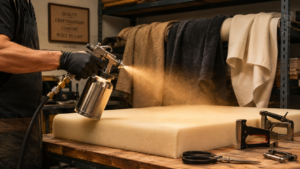
Spray application plays a huge role in curing performance. With the right spray gun and hose setup, you get:
- Uniform adhesive thickness
- Better airflow exposure
- Faster and more consistent curing
- Reduced waste
Uneven application leads to uneven curing and uneven curing leads to callbacks. Nobody wants that.
Real-World Example: When Curing Time Is Ignored
A furniture manufacturer rushed assembly to meet a deadline. The adhesive felt dry, so production moved forward. Two weeks later? Bond failure during shipping.
The adhesive wasn’t defective.
The equipment wasn’t faulty.
The curing time was ignored.
Understanding adhesive properties would have prevented thousands in losses and a very uncomfortable phone call.
The Bottom Line on Adhesive Curing
Adhesives don’t fail randomly. They fail because:
- Curing time wasn’t respected
- Environmental conditions weren’t controlled
- Application wasn’t consistent
When you understand adhesive properties and curing behavior, you get:
- Stronger bonds
- Longer-lasting results
- Fewer headaches
And that’s good business.
Frequently Asked Questions About Adhesive Curing
How long does adhesive take to cure completely?
It depends on the adhesive type, environment, and application method. Full curing can range from minutes to several days.
Can adhesive cure faster with heat?
Sometimes, too much heat can weaken the bond. Always follow manufacturer recommendations.
Is dry adhesive the same as cured adhesive?
No. Dry means the surface feels set. Cured means the adhesive has reached full strength.
Do spray adhesives cure faster than brushed adhesives?
Often yes, because spray application creates thinner, more uniform layers that cure more consistently.
What happens if adhesive isn’t fully cured?
The bond may fail under stress, temperature changes, or vibration; even if it looked fine initially.
Ready to Apply Adhesives the Right Way?
Curing time starts with proper application. That means reliable spray guns, durable hoses, and equipment designed for industrial adhesives, not shortcuts.
👉 Visit our shop today to find professional-grade spray guns and hoses built to support consistent application, proper curing, and long-lasting bonds.
Because when your adhesive performs, your entire operation sticks to the landing.